
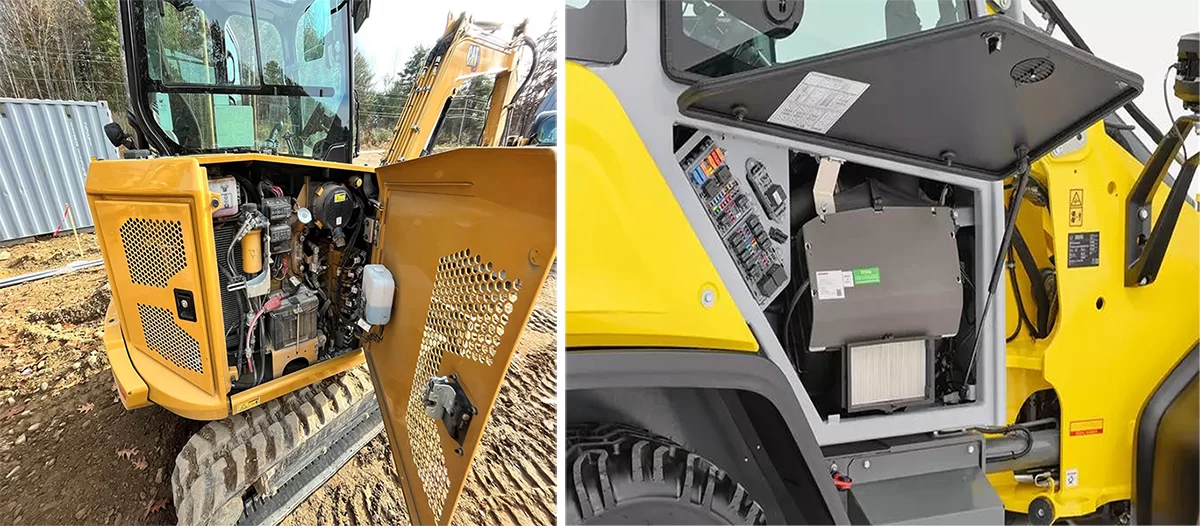
Construction equipment access hardware must protect service panels, doors and compartments while still allowing fast, repeatable maintenance access. On excavators, wheel loaders, cranes and other mobile machines, heavy equipment access hardware is exposed to vibration, shock, dust, moisture and changing outdoor conditions.
The right combination of latches, hinges and handles does more than keep a panel closed. It supports controlled movement, reliable retention and practical access throughout the working life of the machine. This guide explains how cam latches, exposed hinges, bow handles and paddle latches are used in construction and heavy equipment applications.
Quick answer: match the hardware to the panel function. The hinge supports movement, the handle provides a gripping point and the latch retains the panel in its closed position.
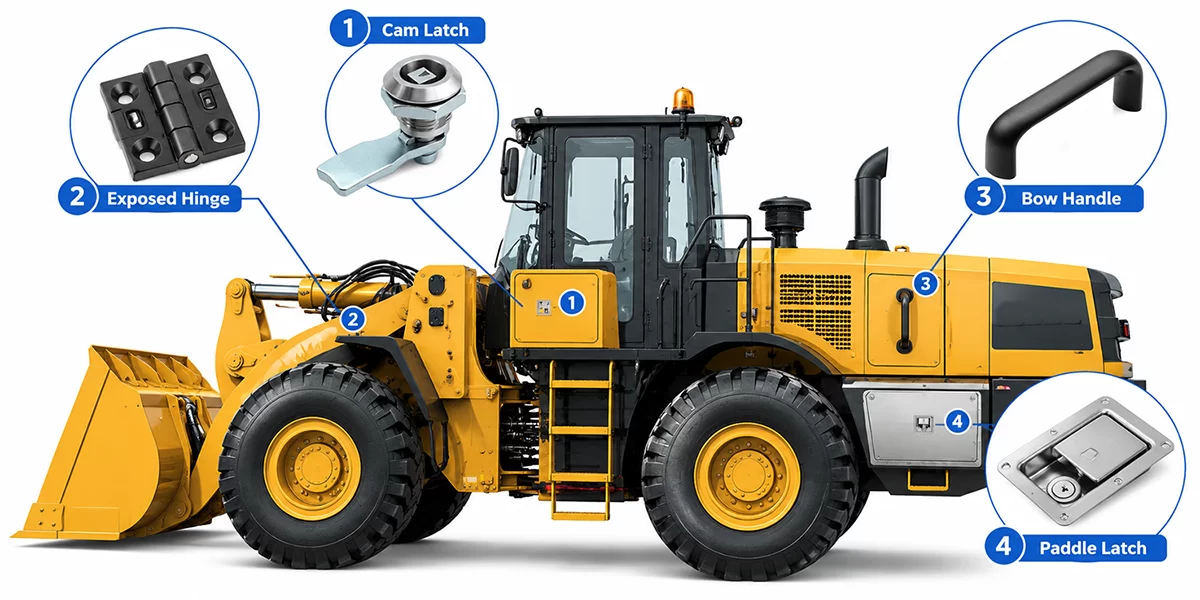
Four Core Access Hardware Components
A complete access system may use several hardware types at the same time. Each component performs a different job, so selecting the correct combination can improve accessibility, panel retention and long-term reliability.
1. Cam Latches — Compact Locking for Service Panels
Cam latches provide a simple and compact method of securing access panels. Turning the actuator rotates a cam behind the frame, securing or releasing the panel. Their small installation footprint makes them particularly useful where space is limited.
Typical applications
- Electrical service panels
- Control compartments
- Filter access covers
- Small inspection panels
- Maintenance covers
Why use a cam latch?
- Compact installation: suitable for smaller access panels where installation space is limited.
- Fast operation: quarter-turn designs allow panels to be opened and closed quickly during maintenance.
- Different access methods: tool-operated, key-operated and other actuator designs can suit different access-control needs.
- Flexible cam configurations: different cam lengths and offsets accommodate different panel and frame geometries.
Selection considerations: check panel thickness, grip, cutout dimensions, cam length, cam offset, rotation direction, required access control and environmental exposure. A cam latch should not be selected based only on its external dimensions; correct cam engagement and grip are critical to reliable panel retention.
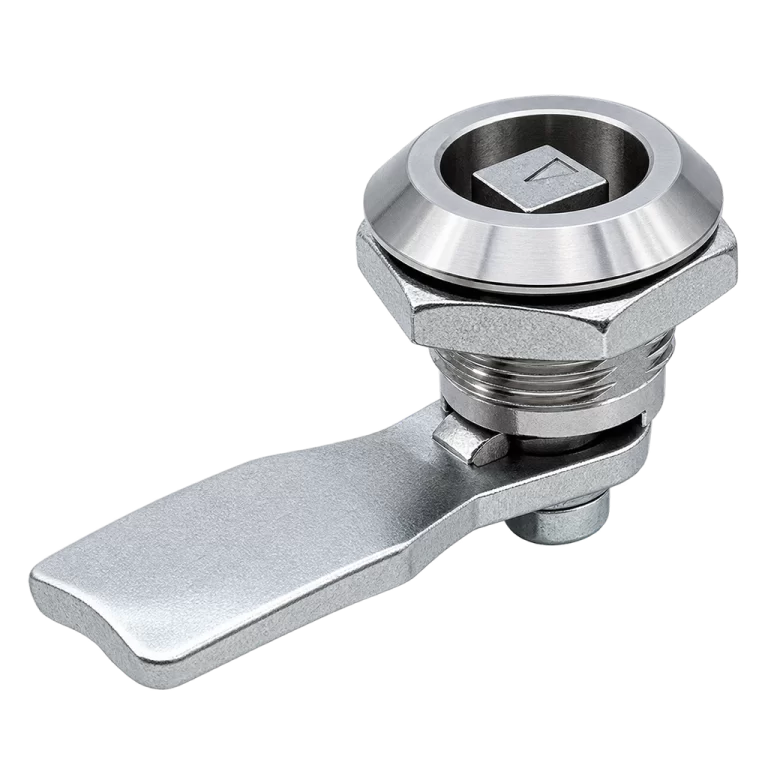
Explore: Mineon Cam Latches
2. Exposed Hinges — Supporting Repeated Door Movement
A latch holds a panel closed, but the hinge carries and controls the movement of the door. On construction equipment, exposed hinges are commonly used where a robust and accessible hinge arrangement is required. Because the hinge is mounted externally, installation and inspection can also be straightforward.
Typical applications
- Engine access panels
- Service doors
- Electrical compartment doors
- Equipment covers
- Storage compartment doors
Why use an exposed hinge?
- Simple installation: the hinge can be mounted directly to accessible surfaces.
- Range of sizes and materials: different configurations can accommodate door sizes and operating environments.
- Suitable for repeated access: useful for service panels opened regularly during inspection and maintenance.
- Easy inspection: the exposed mounting arrangement keeps the hinge and fasteners readily visible.
Selection considerations: consider door weight, door dimensions, center of gravity, number of hinges, hinge spacing, opening angle, fastener strength, vibration and shock, material and corrosion resistance. Door weight alone does not determine hinge load; door geometry and the position of the center of gravity also affect the forces acting on the hinges.
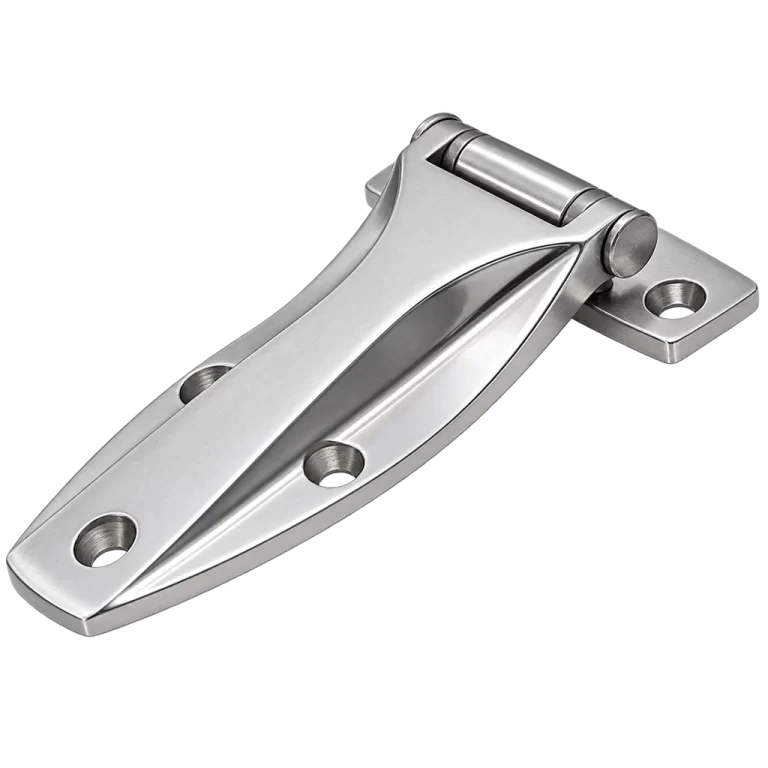
Explore: Mineon Exposed Hinges
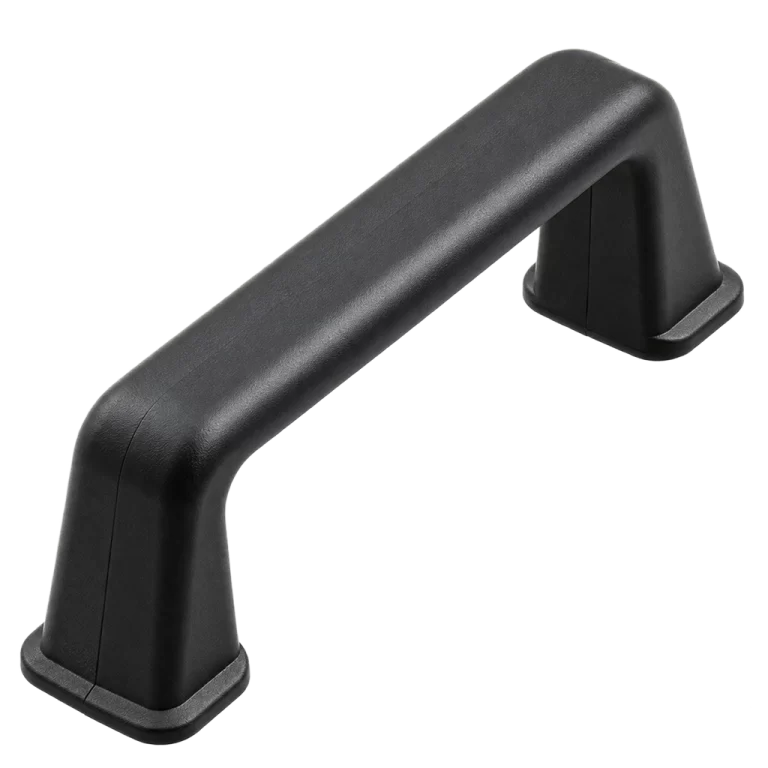
3. Bow Handles — Simple and Reliable Manual Access
Not every access component needs an integrated locking mechanism. Bow handles provide a clear gripping point for opening, closing or positioning equipment doors and panels. On construction machinery, they are useful where operators or maintenance personnel need a durable handhold.
Typical applications
- Engine compartment doors
- Service panels
- Equipment covers
- Storage doors
- Maintenance access panels
Why use a bow handle?
- Simple operation: the user immediately understands where to grip the panel.
- Dedicated function: the handle provides a pulling or lifting point without adding a complicated mechanism.
- Multiple mounting options: different lengths and mounting configurations suit different door designs.
- Works with separate locking hardware: a bow handle can be combined with a cam latch or another retention system.
A handle and latch do not necessarily perform the same function. The handle provides a gripping point; the latch provides panel retention. Keeping these functions separate can provide greater flexibility in access-panel design.
Selection considerations: check handle length, grip clearance, mounting-hole spacing, fastener strength, expected pulling force, glove clearance, door geometry, material and surface finish. Sufficient hand clearance is particularly important when operators are wearing work gloves.
Explore: Mineon Bow Handles
4. Paddle Latches — Integrated Access for Compartments
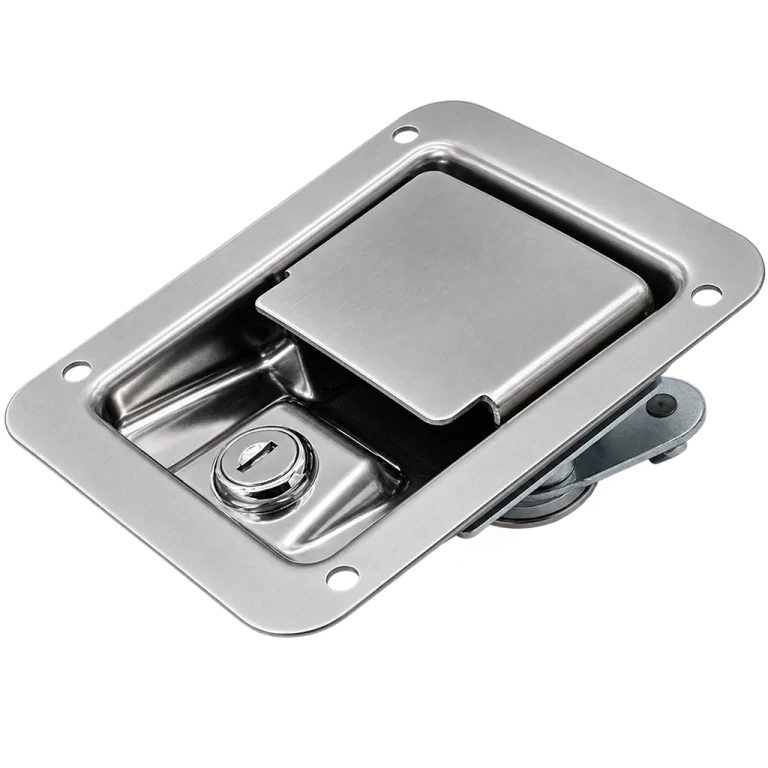
Paddle latches combine a recessed operating handle and latching mechanism into a compact assembly. This makes them suitable for equipment compartments where convenient hand operation and a relatively flush exterior surface are required.
Typical applications
- Toolboxes
- Side storage compartments
- Battery compartments
- Utility compartments
- Equipment storage doors
Why use a paddle latch?
- Recessed installation: the operating handle sits largely within the latch body, reducing external protrusion.
- Convenient hand operation: the paddle provides an intuitive opening action.
- Integrated locking function: the handle and latch mechanism are combined into one assembly.
- Key-locking options: selected designs can provide controlled access to tools or equipment.
- Stainless-steel options: useful where increased corrosion resistance is required.
For a toolbox or exterior compartment, a stainless-steel paddle latch can be a practical choice because moisture, dirt and repeated cleaning may influence material selection.
Selection considerations: confirm panel cutout, panel thickness, installation depth, keeper position and locking requirements before specifying the latch.
Explore: Mineon Paddle Latches
How the Four Components Work Together
An equipment access system can use several types of hardware simultaneously. The best combination depends on the door function, the required access frequency, available installation space and the loads created during operation.
| Equipment access area | Typical combination | Primary role |
|---|---|---|
| Electrical service panel | Cam latch + exposed hinges | The hinge supports the panel while the cam latch retains it closed. |
| Engine access door | Exposed hinges + bow handle + latching system | The hinges support movement, the handle provides grip and the latch secures the panel. |
| Toolbox | Paddle latch + hinges | The paddle latch combines access and locking, while the hinges control door movement. |
Hinge = supports movement · Handle = provides manual access · Latch = retains the panel
Design Factors for Construction Equipment
Vibration and shock
Construction machinery is frequently exposed to vibration and shock during operation. These conditions can affect the entire access system and may lead to panel rattling, fastener loosening, hinge wear, changes in latch engagement, panel deformation, noise and reduced service life.
The correct approach is not simply to select a component described as heavy-duty. Consider the complete system: Panel → Hinge → Handle → Latch → Fasteners → Frame. A strong latch cannot compensate for an inadequately supported door or loose hinge installation.
Material and corrosion resistance
Construction equipment may operate outdoors for long periods and can be exposed to rain, mud, humidity and cleaning processes. Material selection should therefore reflect the actual environment and the mechanical load.
- Zinc alloy: often suitable where mechanical performance, design flexibility and cost efficiency must be balanced.
- Steel: can provide good mechanical strength and may be combined with suitable surface treatments.
- Stainless steel: should be considered for exterior compartments, toolboxes, high-humidity environments, frequently washed equipment and aggressive industrial conditions.
Stainless steel is not automatically required for every component. A practical material decision balances environment + mechanical load + corrosion requirement + cost.
Installation geometry matters
Even a correctly selected hardware type can perform poorly if the installation geometry is wrong. Confirm the following before specifying hardware:
- Cam latches: panel thickness, grip, cam dimensions, cutout and rotation direction.
- Exposed hinges: door dimensions, door weight, hinge spacing, mounting-hole pattern and opening angle.
- Bow handles: hole spacing, grip clearance, handle length and mounting strength.
- Paddle latches: panel cutout, panel thickness, installation depth, keeper position and locking requirements.
Where possible, selection should be based on actual drawings and dimensions rather than photographs alone.
Quick Selection Guide
| Hardware | Typical equipment area | Primary function | Key selection factors |
|---|---|---|---|
| Cam latch | Electrical or service panel | Panel retention | Grip, cam and cutout |
| Exposed hinge | Access doors or covers | Support door movement | Load, spacing and opening angle |
| Bow handle | Engine or service panel | Manual gripping | Clearance, size and mounting |
| Paddle latch | Toolbox or compartment | Access and latching | Cutout, depth and security |
Final Selection Checklist
Before selecting access hardware for construction equipment, confirm:
- Function of the panel or door
- Door dimensions and weight
- Panel thickness
- Required access frequency
- Latch grip and cam geometry
- Hinge load and spacing
- Handle clearance
- Paddle-latch cutout and installation depth
- Vibration and shock
- Outdoor exposure and corrosion environment
- Material and surface finish
- Required locking method
Access hardware should be selected as a complete system rather than treating each component independently. The result is a more practical balance between service access, panel retention, operator comfort and long-term durability.
Need Help Selecting Access Hardware?
Mineon provides cam latches, exposed hinges, bow handles and paddle latches for construction machinery, industrial equipment and other demanding applications. Share your application drawing, panel dimensions, door weight, cutout and operating environment to help identify suitable hardware for your application.
Read our stories to find out how to address your Industry Challenges
Access Hardware for Construction and Heavy Equipment: Latches, Hinges and Handles
Learn how cam latches, exposed hinges, bow handles and paddle latches are used on construction and heavy equipment, and what to consider…
How to Select Latches for Electrical Enclosures and Control Cabinets
Learn how to choose cam, compression and multi-point latches for electrical enclosures and control cabinets based on sealing, vibration, grip range, materials…
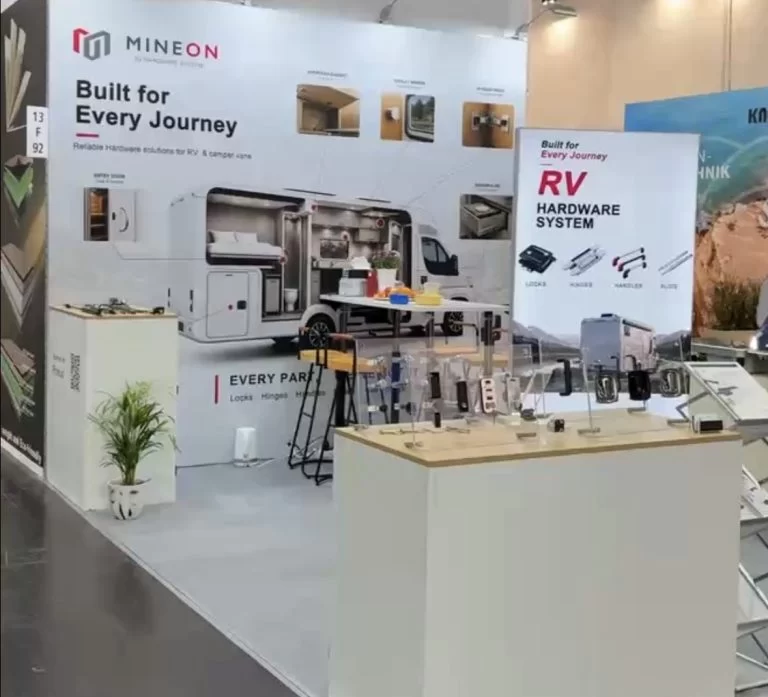
Mineon at CARAVAN SALON Düsseldorf 2026: Connecting with the Global RV Industry
Mineon has successfully concluded its participation in CARAVAN SALON Düsseldorf 2026 (held from August 28 to September 6).As the world’s leading trade…
